

ICEGATE Registration Process Step by Step: Detailed Guide for Exporters and Importers
Continuing the ICEGATE Registration Journey
After completing the initial preparation described in Part 1, businesses should move carefully through the actual registration journey.
The ICEGATE Registration Process should not be treated as a simple form-filling exercise. The information entered during registration should accurately reflect official business records and the applicant's authorized role.
For exporters and importers, registration readiness is closely connected with:
- Business identity
- PAN details
- IEC information
- GST information, where applicable
- Authorized person details
- Registered contact information
- Banking arrangements
- AD Code requirements
- Customs and port-specific procedures
A well-prepared business can complete its international trade activities more efficiently because its core information is organized before a shipment becomes urgent.
CTA: Before starting your first import or export shipment, organize your business and logistics documentation. Reinforce Logistics Private Limited can support your international freight forwarding and customs clearance planning.
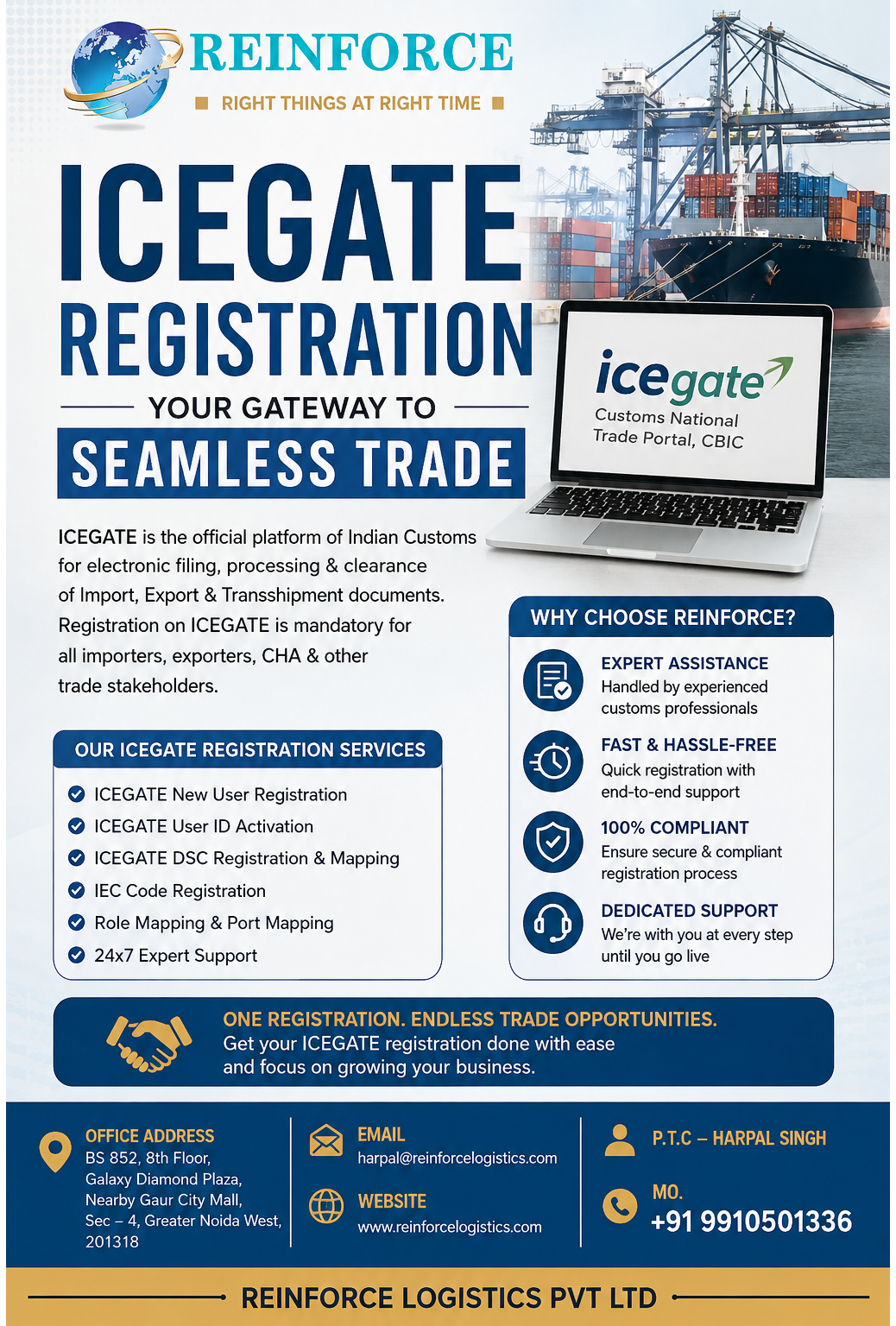
ICEGATE Registration Process Step by Step
The exact screens, fields, verification methods, and workflow on government portals may change over time. Therefore, users should always follow the latest instructions available on the official ICEGATE platform.
However, the following practical process explains how businesses should approach How to Register on ICEGATE.
Step 1: Access the Official ICEGATE Registration Section
The first step is to access the official ICEGATE platform and locate the registration option.
Businesses should ensure that they are using the official government portal and not relying on third-party websites claiming to provide official registration.
When accessing the portal:
- Check that you are on the official ICEGATE website.
- Review the latest registration advisories.
- Read applicable user guidance.
- Select the registration option relevant to your business.
Business Recommendation
Before entering any information, download or review the applicable official guidance.
This helps the applicant understand the required information before beginning the process.
Step 2: Select the Correct User Type
Selecting the correct user category is one of the most important steps in the ICEGATE Registration Process.
Different stakeholders perform different functions in international trade.
Common categories may include:
- Importer
- Exporter
- Customs Broker
- Freight Forwarder
- Shipping Line
- Shipping Agent
- Airline
- Console Agent
- Custodian
- NVOCC
- Other eligible trade participants
Why Does User Type Matter?
Your user category determines the type of business information and authorization requirements that may apply.
Example 1: Manufacturer Exporter
A company manufactures automotive components in Greater Noida and exports them directly to customers in Europe.
The company should follow the registration requirements applicable to its exporter role.
Example 2: Freight Forwarder
A logistics company arranges transportation and coordinates international cargo movements for multiple customers.
Its operational role differs from that of an exporter.
Example 3: Importer
A Delhi-based company imports industrial machinery from China for its manufacturing facility.
The importer should follow procedures applicable to its role and transaction.
Important Tip
Do not select a user category based on what another company uses.
Select the category that correctly represents your legal and operational role.
Step 3: Enter Accurate Business Details
After selecting the appropriate category, the applicant may be required to enter business information.
This information should match official records.
Before submission, verify:
- Legal business name
- PAN
- IEC, where applicable
- GSTIN, where applicable
- Registered address
- Contact information
- Authorized person details
The Golden Rule: One Business, One Consistent Identity
Your company should appear consistently across important documents.
For example:
Correct approach:
ABC Engineering Private Limited
PAN: Registered under the correct legal entity
IEC: Issued in the same legal name
GST: Correctly linked to the business
Bank: Account held in the company's correct name
Potential problem:
ABC Engineering Pvt Ltd on one document
ABC Engineers on another document
ABC Engineering Company on a bank document
Differences may create additional verification requirements.
Step 4: Verify Contact Details
Your registered mobile number and email address are important business assets.
They should not belong exclusively to a temporary employee.
Best Practice for Businesses
Use an official company email such as:
This ensures continuity.
Avoid This Situation
An export executive registers an official trade account using a personal email address.
The employee leaves the company.
The company later cannot easily access important communications.
Better Approach
Use a centrally controlled company email address.
Maintain secure access with authorized management personnel.
Step 5: Complete Applicable Verification
Depending on the user category and current ICEGATE workflow, verification of submitted information may be required.
The purpose of verification is to establish that:
- The business information is valid.
- The applicant is associated with the business.
- Identity details are accurate.
- Contact details are correct.
- The applicant is authorized to act for the organization.
Businesses should follow the instructions displayed on the official platform.
Important Advice
Do not submit false or estimated information.
For example:
Do not guess:
- PAN details
- IEC information
- GST information
- Bank branch information
- Authorized person details
Always verify information from official documents before submission.
Step 6: Create and Secure User Credentials
Once the applicable registration and verification process is completed, businesses should manage their credentials securely.
Recommended Internal Policy
Do not share passwords openly through:
- WhatsApp groups
- Public email chains
- Shared documents
- Unsecured spreadsheets
Instead:
- Limit access to authorized employees.
- Maintain a controlled credential policy.
- Update access when employees leave.
- Keep recovery details under management control.
For companies handling regular import-export operations, access control should be part of the compliance process.
Step 7: Maintain Registration Records
After completing registration, maintain proper records.
Create a secure folder containing:
- Registration acknowledgement
- User details
- Authorization documents
- Relevant confirmation emails
- Official communications
- Supporting documents
A simple digital folder structure can be:
International Trade Compliance
→ ICEGATE
→ IEC
→ GST
→ PAN
→ Banking
→ AD Code
→ Customs Documents
→ Export Shipments
This structure helps businesses locate documents quickly.
What Happens After ICEGATE Registration?
Registration is not the final step in international trade preparation.
Businesses should next focus on their operational readiness.
For exporters, this may include:
- Banking arrangements
- AD Code requirements
- Applicable customs procedures
- Product documentation
- Freight planning
- Customs clearance arrangements
For importers, this may include:
- Product classification
- Import documentation
- Customs duty planning
- Freight arrangements
- Customs clearance planning
Important Business Principle
Registration gives access and readiness. Shipment success depends on proper documentation and logistics execution.
Understanding AD Code Registration
One of the most frequently searched topics along with ICEGATE is AD Code Registration.
AD Code refers to the Authorized Dealer Code associated with the bank branch handling foreign exchange-related transactions.
For exporters, applicable AD Code procedures are important because export transactions involve coordination between:
- Exporter
- Authorized Dealer bank
- Customs systems
- Customs location
- Export documentation
Why Is AD Code Important?
The purpose of export banking arrangements is to ensure proper handling and reporting of international trade transactions through authorized banking channels.
An exporter should coordinate with its authorized bank to understand:
- Applicable AD Code procedures
- Required bank documentation
- Export realization procedures
- Relevant banking compliance requirements
Practical Example
A pharmaceutical company in Delhi NCR exports products to the Middle East.
The company has:
- Valid business registrations
- IEC
- Export order
- Commercial invoice
- Packing list
However, before shipment, it should also ensure that applicable export banking and customs requirements are properly addressed.
The exporter should not wait until the shipment reaches the airport to discover that additional banking or registration procedures are required.
ICEGATE Registration vs AD Code Registration
Businesses frequently confuse ICEGATE Registration and AD Code Registration.
They are not the same.
RequirementMain PurposeRelated StakeholderICEGATE RegistrationAccess to applicable electronic customs servicesTrade stakeholdersAD CodeExport banking and authorized dealer identificationExporters and banksIECImport-export identificationImporters and exportersGSTApplicable tax registrationEligible businessesIFSC CodeIdentification of a bank branchBanking system
Simple Explanation
Think of international trade as a complete system.
IEC identifies your import-export business.
ICEGATE Registration connects eligible users with the electronic customs ecosystem.
AD Code arrangements relate to authorized dealer banking procedures for exports.
IFSC Code identifies the relevant bank branch electronically.
Each has a different purpose.
What Is IFSC Code Registration?
An IFSC Code identifies a specific bank branch within India's electronic banking network.
For businesses involved in international trade, accurate bank information is important.
However, businesses should understand that an IFSC Code itself is a bank branch identification code. The exact banking or customs process where IFSC details are required depends on the applicable transaction and current procedure.
Why Correct IFSC Information Matters
Incorrect bank information can create:
- Verification delays
- Banking communication issues
- Documentation corrections
- Payment processing concerns
Example
An exporter changes its bank branch.
The company continues using the old IFSC Code from a previous document.
This creates inconsistency between current bank records and submitted information.
Better Approach
Whenever banking arrangements change:
- Obtain updated details from the bank.
- Update internal records.
- Review any trade-related registrations requiring updated information.
- Inform relevant service providers where necessary.
Port-Specific and Customs Location Requirements
One important mistake businesses make is assuming that every customs location follows identical operational procedures.
India has multiple customs ports and cargo locations, including:
- Delhi Air Cargo
- ICD Tughlakabad
- ICD Dadri
- Nhava Sheva
- Mundra
- Chennai
- Kolkata
- Bengaluru
- Hyderabad
- Other airports, seaports, and inland customs locations
The operational requirements for your shipment may depend on:
- Type of cargo
- Customs location
- Export or import procedure
- Bank and AD Code arrangements
- Product category
- Applicable regulations
Example: Delhi NCR Exporter
A company located in Noida may manufacture goods in Greater Noida.
Its cargo movement may involve:
Factory → Local Transport → ICD or Airport → Customs Clearance → Airline or Shipping Line → Overseas Destination
The exporter should confirm the applicable customs location before moving cargo.
This helps ensure that documentation and operational planning are aligned.
CTA: Reinforce Logistics Private Limited can help businesses plan international cargo movement from Delhi NCR through appropriate air cargo terminals, ICDs, ports, and logistics networks.
Practical Example: Textile Exporter
Consider a textile exporter based in Delhi NCR.
The company receives a purchase order from a customer in the United Kingdom.
The shipment contains finished garments.
The business should follow a structured process.
Stage 1: Confirm the Order
Check:
- Product description
- Quantity
- Price
- Delivery terms
- Delivery location
Stage 2: Prepare the Goods
Ensure:
- Proper packaging
- Correct labeling
- Accurate carton details
Stage 3: Prepare Documents
Typically, commercial shipment documentation may include:
- Commercial invoice
- Packing list
- Purchase order
- Other documents required for the product or transaction
Stage 4: Review Banking and Trade Readiness
Confirm:
- IEC status
- Applicable banking arrangements
- Applicable AD Code procedures
- Relevant customs requirements
Stage 5: Plan Freight
Decide whether the shipment should move through:
- Air freight
- Sea freight
- Courier
- Other suitable logistics solutions
Stage 6: Arrange Customs Clearance
Coordinate customs procedures through authorized professionals.
Stage 7: Dispatch Cargo
Move cargo according to the confirmed logistics plan.
This structured process reduces confusion.
Common ICEGATE Registration Mistakes Businesses Should Avoid
Mistake 1: Waiting Until Cargo Is Ready
This is one of the biggest problems.
Wrong Approach
Receive order → Produce goods → Pack cargo → Discover registration issues.
Correct Approach
Prepare registrations → Verify banking → Plan customs → Produce goods → Book freight → Dispatch cargo.
Mistake 2: Entering Incorrect Company Information
Never rely on memory.
Check official documents.
Even minor errors in:
- Company name
- PAN
- IEC
- GSTIN
- Address
can create unnecessary work.
Mistake 3: Using a Former Employee's Contact Details
This creates long-term access problems.
Use centrally controlled company contact information.
Mistake 4: Not Understanding the Correct User Role
A freight forwarder, importer, and exporter do not necessarily have identical requirements.
Always select the appropriate category.
Mistake 5: Ignoring Banking Requirements
Businesses sometimes focus only on customs.
However, export transactions also involve banking processes.
Coordinate with your authorized bank early.
Mistake 6: Assuming Every Port Works the Same Way
Always check operational requirements for the actual customs location.
Mistake 7: Relying Only on Verbal Information
International trade involves multiple stakeholders.
Important instructions should be documented.
Maintain written confirmation for:
- Freight rates
- Shipment instructions
- Payment terms
- Cargo details
- Documentation requirements
Expert Tips for ICEGATE Registration and Export Readiness
Expert Tip 1: Create a Trade Compliance File
Maintain all important documents in one secure location.
Include:
- PAN
- IEC
- GST
- Company registration documents
- Bank details
- AD Code documents
- Authorized signatory documents
Expert Tip 2: Review Your Information Every Six Months
Businesses change.
You may change:
- Office address
- Directors
- Partners
- Bank branch
- Authorized signatory
- Mobile number
- Email address
Conduct a regular review.
Expert Tip 3: Do Not Wait for Your First Order
Complete basic trade readiness before receiving an urgent international order.
This creates a competitive advantage.
A buyer may require shipment within five days.
A prepared exporter can respond faster than a company that is starting its compliance process after receiving the order.
Expert Tip 4: Separate Compliance From Daily Operations
Assign clear responsibility.
For example:
Sales Team: Receives export order.
Documentation Team: Prepares commercial documents.
Finance Team: Handles banking coordination.
Logistics Partner: Coordinates freight and cargo movement.
Management: Approves commercial decisions.
Clear responsibility reduces mistakes.
Why ICEGATE Readiness Is Important for MSMEs
MSMEs often have fewer employees managing multiple responsibilities.
One person may handle:
- Sales
- Purchase
- Documentation
- Customer communication
- Logistics
This creates operational pressure.
A documented workflow can make international trade easier.
Recommended MSME Workflow
Before Exporting
Complete basic business and trade readiness.
Before Receiving Cargo
Prepare the documentation checklist.
Before Booking Freight
Confirm cargo:
- Weight
- Dimensions
- Packaging
- Pickup address
Before Customs Clearance
Review all applicable shipment documents.
Before Dispatch
Confirm:
- Consignee details
- Shipping instructions
- Invoice
- Packing list
This disciplined approach can significantly improve operational control.
Air Freight vs Sea Freight for Exporters
ICEGATE and customs readiness are only part of the overall export process.
Businesses must also select the correct transportation method.
FactorAir FreightSea FreightSpeedFasterSlowerSuitable ForUrgent cargoLarger shipmentsTypical CostHigher per kgOften economical for large volumesCargo VolumeSmall to medium shipmentsMedium to large shipmentsCommon UsersPharma, electronics, urgent partsManufacturers and bulk exporters
When Should You Choose Air Freight?
Air freight may be suitable when:
- Delivery is urgent.
- Product value is high.
- Production is delayed and the buyer deadline is close.
- The shipment is relatively compact.
When Should You Choose Sea Freight?
Sea freight may be suitable when:
- Cargo volume is high.
- Transit time is flexible.
- Freight cost optimization is important.
CTA: Need Help Selecting Air or Sea Freight?
Reinforce Logistics Private Limited can evaluate your cargo dimensions, shipment urgency, destination, and logistics requirements to help identify a suitable transportation solution.
Why Choose Reinforce Logistics Private Limited?
International shipping requires more than moving cargo from Point A to Point B.
A professional logistics partner helps coordinate:
- Cargo pickup
- Freight planning
- Air freight
- Sea freight
- Customs clearance coordination
- Warehousing
- Documentation planning
- International delivery coordination
Reinforce Logistics Private Limited supports businesses involved in international trade with practical logistics solutions.
The company serves businesses from Delhi NCR with Pan India operations and supports global freight movement through international logistics networks.
Industries That Can Benefit
Reinforce Logistics supports logistics planning for businesses such as:
- MSMEs
- Manufacturers
- Engineering companies
- Pharmaceutical companies
- Textile exporters
- Automobile component manufacturers
- Industrial companies
- E-commerce sellers
- Importers
- Exporters
A Single Logistics Partner Can Improve Coordination
Instead of separately coordinating with:
- Local transporters
- Airlines
- Shipping lines
- Customs representatives
- Warehouses
businesses can work with an experienced logistics partner to coordinate the shipment process.
This improves communication and operational visibility.
Part 2 Checklist: ICEGATE Registration Readiness
Before proceeding, check the following:
Business Information
☐ Legal company name verified
☐ PAN details verified
☐ IEC details reviewed
☐ GST information reviewed, where applicable
☐ Registered address confirmed
Contact Information
☐ Official mobile number accessible
☐ Official email address active
☐ Authorized person identified
Banking Information
☐ Bank details verified
☐ IFSC information checked
☐ Applicable AD Code procedures reviewed
Customs and Logistics
☐ Correct ICEGATE user category identified
☐ Customs location identified
☐ Product documentation reviewed
☐ Freight mode evaluated
☐ Logistics partner selected
Key Takeaways from Part 2
The ICEGATE Registration Process requires businesses to focus on accuracy, preparation, and consistency.
The most important points are:
✓ Select the correct ICEGATE user category.
✓ Ensure company information matches official records.
✓ Maintain controlled access to registered mobile numbers and email addresses.
✓ Verify banking information before submitting it.
✓ Understand that ICEGATE Registration and AD Code Registration serve different purposes.
✓ Review port-specific and customs-location requirements.
✓ Do not wait until cargo is ready to begin compliance preparation.
✓ Maintain proper documentation for every international shipment.
✓ Work with an experienced logistics partner for freight and operational coordination.
Learn the ICEGATE registration process step by step, including AD Code and IFSC Code registration, documents, benefits, and expert guidance for exporters.