

ICEGATE Registration Process: Complete Step-by-Step Guide for Exporters and Importers
Introduction
The ICEGATE Registration Process is an important step for businesses involved in international trade in India. ICEGATE provides eligible trade users with access to India's electronic customs ecosystem and supports digital interaction with Indian Customs for various import-export activities.
If you are an exporter, importer, manufacturer, MSME, e-commerce seller, freight forwarder, or industrial company, understanding how to register on ICEGATE can help you prepare your business for smoother customs and international trade operations.
For importers and exporters, successful shipment execution involves much more than booking air freight or sea freight. Businesses must also ensure that their business details, Import Export Code (IEC), banking information, authorized user details, and applicable customs registrations are properly maintained.
The current ICEGATE portal directs new trade users to use the Register Now option for registration, while official ICEGATE guidance and advisories provide role-specific information for trade stakeholders.
This comprehensive guide explains the ICEGATE Registration Process step by step, including:
- What ICEGATE is
- Who can register on ICEGATE
- Why ICEGATE Registration is important
- Registration prerequisites
- How exporters and importers should prepare
- The relationship between ICEGATE Registration and AD Code Registration
- IFSC Code and banking information
- Common mistakes to avoid
- Practical examples for businesses
- How a professional logistics partner can support international trade operations
Whether you are planning your first export shipment or managing regular international cargo, proper preparation can reduce unnecessary documentation issues and shipment delays.
Need assistance with international freight forwarding, customs clearance, air freight, sea freight, or import-export logistics? Reinforce Logistics Private Limited supports businesses from Delhi NCR with Pan India logistics operations and global shipping solutions.
What Is ICEGATE?
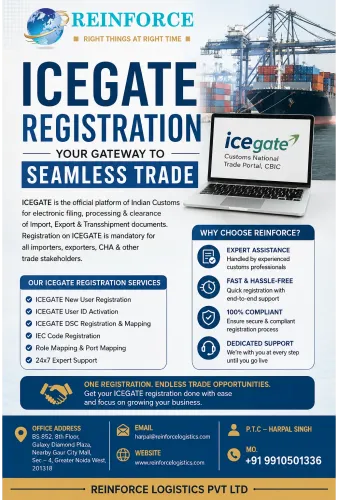
ICEGATE stands for the Indian Customs Electronic Gateway. It is the Indian Customs National Trade Portal and serves as an electronic platform for trade stakeholders interacting with the customs ecosystem.
ICEGATE supports a wide range of customs-related digital services and trade interactions. Its ecosystem connects various stakeholders involved in international trade and customs operations.
According to official ICEGATE information, the platform supports trade users and provides services related to registration, electronic filing, e-payment, enquiries, and other customs-related functions.
In simple business language, ICEGATE acts as an important digital gateway between eligible trade participants and India's customs systems.
Why Is ICEGATE Important for International Trade?
International trade involves several organizations and professionals working together.
A single import or export shipment may involve:
- Exporter
- Importer
- Manufacturer
- Supplier
- Freight forwarder
- Customs broker
- Shipping line
- Airline
- Warehouse operator
- Port terminal
- Inland Container Depot
- Bank
- Government authorities
- Overseas buyer or supplier
Managing these activities manually can create delays and communication gaps.
Digital customs systems help streamline the exchange of information between eligible stakeholders and customs processes.
ICEGATE is therefore an important part of India's digital trade infrastructure.
For businesses, understanding the ICEGATE Registration Process is particularly important before beginning regular import or export operations.
What Does ICEGATE Registration Mean?
ICEGATE Registration generally refers to the process through which eligible trade users register on the ICEGATE platform and obtain access according to their applicable role and permissions.
Official ICEGATE guidance identifies multiple categories of trade users who may be eligible for registration, including importers/exporters, freight forwarders, customs brokers, airlines, shipping lines, shipping agents, console agents, custodians, NVOCCs, and other stakeholders.
The registration process may vary depending on the user's role.
For example:
An Importer or Exporter
An importer or exporter may require registration and access based on their trade activities and applicable customs procedures.
A Freight Forwarder
A freight forwarder may have a different role and registration workflow from an importer or exporter.
A Customs Broker
Customs brokers and their authorized users may have specific registration requirements and role structures.
A Shipping Line or Airline
Shipping lines and airlines interact with customs systems according to their operational role.
For this reason, businesses should always select the correct user category during the registration process.
Who Can Register on ICEGATE?
ICEGATE supports a broad range of trade stakeholders.
Official registration guidance has identified roles that include:
- Importer
- Exporter
- Freight Forwarder
- Customs Broker
- Shipping Line
- Shipping Agent
- Airline
- Console Agent
- Authorized Terminal Operator
- Custodian
- NVOCC
- Participating Government Agency
- Non-IEC or UIN Holder, where applicable
- Other eligible trade stakeholders
The exact eligibility and requirements should always be checked against the latest official ICEGATE registration guidance before submitting an application.
Why Correct Role Selection Is Important
Selecting the wrong role can result in unnecessary complications.
For example, a manufacturer exporting goods should not assume that every ICEGATE registration category provides the same functionality.
Similarly, a logistics company and an exporter may interact with the customs ecosystem differently.
Before starting registration, ask:
What is my business role?
Am I registering as an importer, exporter, freight forwarder, customs broker, or another stakeholder?
Who will be the authorized person responsible for the account?
Are my business records updated?
Answering these questions before registration can save significant time.
Why Should Exporters and Importers Understand the ICEGATE Registration Process?
The ICEGATE Registration Process is relevant because customs operations increasingly depend on electronic systems and digital communication.
Businesses that prepare their registrations and documentation in advance are generally better positioned to manage international shipments efficiently.
1. Better Digital Readiness
Businesses involved in international trade should establish a proper compliance and documentation structure before cargo is ready.
A well-prepared exporter should know:
- Its IEC status
- Applicable ICEGATE requirements
- Banking arrangements
- AD Code requirements
- Customs location
- Product documentation requirements
- Shipping documentation requirements
Waiting until the cargo reaches the airport or port can create unnecessary pressure.
2. Improved Documentation Management
International shipments usually require multiple documents.
Depending on the transaction, these may include:
- Commercial Invoice
- Packing List
- Purchase Order
- Shipping Instructions
- IEC details
- Banking information
- Product certificates
- Licenses, where applicable
- Customs documentation
- Transport documents
Maintaining proper records helps businesses respond quickly when information is required.
3. Better Shipment Planning
A successful export shipment starts long before cargo is handed over to the airline or shipping line.
For example, an engineering exporter in Delhi NCR receives an urgent order from a customer in Europe.
The exporter should not wait until production is complete before reviewing compliance requirements.
Instead, the company should plan:
Order Confirmation → Product Readiness → Documentation → Banking Coordination → Customs Preparation → Freight Booking → Cargo Movement → Customs Clearance → International Transportation
This structured approach reduces last-minute surprises.
ICEGATE Registration Process: Why Preparation Matters
Many first-time exporters make the same mistake.
They focus entirely on getting the international order.
Once the order is received, they focus on production.
Once production is complete, they start looking for a freight forwarder.
Then they discover that certain documentation, registration, banking, or customs requirements need attention.
This can delay the shipment.
The Better Approach
Prepare your international trade framework before receiving an urgent order.
A business should ideally establish:
Business Readiness
Ensure that the legal business structure and applicable registrations are in order.
Trade Readiness
Maintain valid and updated import-export credentials where applicable.
Banking Readiness
Coordinate with the appropriate bank for export-import banking arrangements.
Customs Readiness
Understand applicable ICEGATE and customs procedures.
Logistics Readiness
Identify a reliable freight forwarding and customs clearance partner.
This preparation is particularly important for MSMEs and first-time exporters.
Business Tip: Do not treat customs registration and logistics as activities that begin after cargo is ready. Start planning when you start preparing for international sales.
ICEGATE Registration Prerequisites
Before beginning the registration process, businesses should review the applicable prerequisites for their specific user category.
Official ICEGATE registration FAQs have stated that, for applicable registrations, contact information and identity details may need to correspond with relevant government records, including GSTN and, for importers/exporters, DGFT-linked information. The applicant's name should also match PAN records as required by the registration workflow.
The exact requirements can change, so businesses should always refer to the latest official registration advisory and user guidance.
Basic Information to Keep Ready
Before starting, maintain updated information such as:
- Legal business name
- PAN details
- IEC details, where applicable
- GST information, where applicable
- Registered business address
- Official email address
- Registered mobile number
- Authorized person details
- Applicable banking information
Important Data Consistency Rule
Your business information should be consistent across official records.
For example:
DocumentInformationPANABC Engineering Private LimitedIECABC Engineering Private LimitedGSTABC Engineering Private LimitedBank RecordsABC Engineering Private LimitedICEGATE RegistrationABC Engineering Private Limited
If different records contain conflicting information, verification or correction may be required.
ICEGATE Registration Process Step by Step: Part One
The exact online workflow may differ based on the user category and updates made to the official ICEGATE system. However, businesses can understand the process through the following practical steps.
Step 1: Identify Your Correct Business Role
The first step is understanding why you need ICEGATE Registration.
Are you:
- An exporter?
- An importer?
- A freight forwarder?
- A customs broker?
- A shipping agent?
- An airline?
- Another eligible trade participant?
This is important because different user categories may have different registration and approval requirements.
Example
A textile manufacturer in Noida wants to export garments to the United States.
The company is exporting its own products.
Therefore, it should understand the registration requirements applicable to an importer/exporter rather than assuming that a freight forwarder registration is appropriate.
The freight forwarder handling the cargo may separately have its own role and system access.
Step 2: Verify Your Business Information
Before registering, conduct a simple business data audit.
Check:
✓ Legal company name
✓ PAN details
✓ IEC information
✓ GST information, where applicable
✓ Official email address
✓ Registered mobile number
✓ Authorized person details
✓ Business address
✓ Bank information
This audit may take less than one hour but can prevent days of follow-up later.
Step 3: Ensure Contact Details Are Current
Businesses should ensure that the mobile number and email address used for official processes are accessible.
Avoid using:
- An ex-employee's email address
- A personal email that is no longer monitored
- A mobile number belonging to a former employee
- Temporary contact details
Instead, use controlled business contact information wherever appropriate.
Best Practice
Maintain at least one official email address specifically for:
- Government registrations
- Customs communication
- Banking communication
- Compliance alerts
For example:
exports@yourcompany.com
or
compliance@yourcompany.com
This helps ensure that important communications are not lost when employees leave the organization.
Step 4: Visit the Official ICEGATE Registration System
Businesses should use the official ICEGATE platform for registration.
The official ICEGATE website provides a registration section and directs users who are not registered to use the Register Now option. Current ICEGATE pages also publish registration advisories and user manuals for trade users.
Official ICEGATE Registration Information
Important Warning
Do not depend solely on:
- Unofficial websites
- Old screenshots
- Random social media videos
- Unverified consultants
- Outdated blog posts
Government portal workflows can change.
Always verify the current process through official ICEGATE guidance.
How to Register on ICEGATE: A Practical Business Approach
Instead of treating ICEGATE Registration as an isolated task, businesses should consider it part of their overall international trade setup.
Recommended Preparation Sequence
Stage 1: Business Compliance
Review your core business registrations.
Stage 2: Import-Export Readiness
Review IEC and other applicable trade requirements.
Stage 3: Banking Preparation
Coordinate with your bank regarding applicable export-import banking procedures.
Stage 4: ICEGATE Readiness
Review the correct registration category and current prerequisites.
Stage 5: Customs Readiness
Understand the customs location through which your shipment will move.
Stage 6: Logistics Planning
Finalize your freight forwarding and cargo movement strategy.
Real Business Example: MSME Exporter in Delhi NCR
Consider a small engineering company based in Greater Noida.
The company manufactures precision machine components and receives its first international order from Germany.
The buyer requests delivery within four weeks.
The company immediately starts production.
However, production is only one part of the process.
The exporter also needs to consider:
- Import-export documentation
- Banking arrangements
- Applicable ICEGATE procedures
- Customs clearance
- Cargo transportation
- Packaging
- Air freight or sea freight
- Delivery timeline
If the company waits until the goods are packed before checking these requirements, the shipment may face avoidable delays.
A better workflow is:
Day 1: Confirm international order.
Day 2–3: Review documentation and trade readiness.
Day 3–5: Confirm banking and applicable customs requirements.
Week 2: Finalize freight planning.
Week 3: Prepare export documentation.
Week 4: Move cargo for customs clearance and international dispatch.
This proactive approach creates better control over the shipment.
ICEGATE Registration and International Logistics
ICEGATE Registration is only one component of international trade.
A successful shipment requires coordination between multiple operational stages.
Complete Export Logistics Workflow
1. Customer Order
The overseas customer places an order.
2. Production
The manufacturer prepares the goods.
3. Quality Check
The exporter confirms that the cargo meets buyer requirements.
4. Documentation
Commercial and shipment documents are prepared.
5. Banking Coordination
Applicable banking requirements are reviewed.
6. Customs Preparation
The customs clearance process is planned.
7. Freight Booking
Air freight or sea freight is booked.
8. Cargo Movement
Cargo moves from the factory or warehouse to the customs location.
9. Customs Clearance
Applicable export clearance procedures are completed.
10. International Transportation
Cargo is transported to the overseas destination.
11. Final Delivery
The overseas consignee receives the shipment.
Each stage affects the next stage.
That is why experienced logistics coordination is valuable for businesses involved in regular international trade.
Why Work With a Professional Logistics Partner?
International freight forwarding requires coordination between multiple service providers.
For example, a single export shipment from Delhi NCR may involve:
- Factory
- Local transporter
- Warehouse
- Customs broker
- Airline
- Airline handling agent
- Overseas freight partner
- Destination delivery agent
Managing every stakeholder independently can consume significant management time.
A professional logistics partner helps businesses coordinate the overall movement of cargo.
Reinforce Logistics Private Limited
Reinforce Logistics Private Limited provides logistics support for businesses involved in international trade.
The company supports clients with services such as:
- International Freight Forwarding
- Air Freight
- Sea Freight
- Import Logistics
- Export Logistics
- Customs Clearance Coordination
- Warehousing
- Door-to-Door Logistics
With a business presence serving Delhi NCR and Pan India operations, Reinforce Logistics can support manufacturers, MSMEs, exporters, importers, industrial companies, e-commerce businesses, engineering companies, textile exporters, and other organizations with international cargo requirements.
Why Logistics Planning Should Start Early
A freight forwarder should ideally be involved before the cargo is completely ready.
Early planning can help businesses consider:
- Cargo dimensions
- Chargeable weight
- Packaging
- Freight mode
- Transit time
- Port selection
- Customs clearance planning
- Pickup arrangements
- Documentation coordination
This can reduce last-minute operational pressure.
CTA: Planning an import or export shipment? Reinforce Logistics Private Limited can help you evaluate your cargo movement, customs clearance requirements, air freight, sea freight, and international logistics strategy before your shipment is dispatched.
Key Takeaways from Part 1
The ICEGATE Registration Process should be viewed as part of a wider import-export readiness framework.
Before starting international shipments, businesses should:
✓ Understand their correct ICEGATE user role.
✓ Keep PAN, IEC, GST, and business information updated.
✓ Maintain accessible official mobile and email details.
✓ Verify applicable banking arrangements.
✓ Understand the relationship between customs readiness and logistics planning.
✓ Start documentation planning before cargo is ready.
✓ Use official ICEGATE guidance for the latest registration requirements.
✓ Work with experienced logistics professionals for freight and shipment coordination.
Learn the ICEGATE registration process step by step, including AD Code and IFSC Code registration, documents, benefits, and expert guidance for exporters.