

Introduction
If you are planning to export goods from India, AD Code Registration at ICEGATE should be part of your export-readiness checklist.
An AD Code, or Authorized Dealer Code, identifies the Authorized Dealer bank branch associated with your foreign-exchange transactions. ICEGATE provides a facility for registered users to add and manage bank accounts under the Foreign Remittance Account (Authorized Dealer Code) category.
For exporters in Delhi NCR, this becomes particularly relevant when shipments are planned through customs locations such as ICD Dadri, ICD Tughlakabad or Delhi Air Cargo.
The important point is simple:
Do not wait until your cargo is ready to move before checking your AD Code, ICEGATE registration and customs-location requirements.
Reinforce Logistics Private Limited helps exporters coordinate customs clearance, freight forwarding and international logistics from its Greater Noida, Delhi NCR base with Pan India operations.
What Is AD Code Registration at ICEGATE?
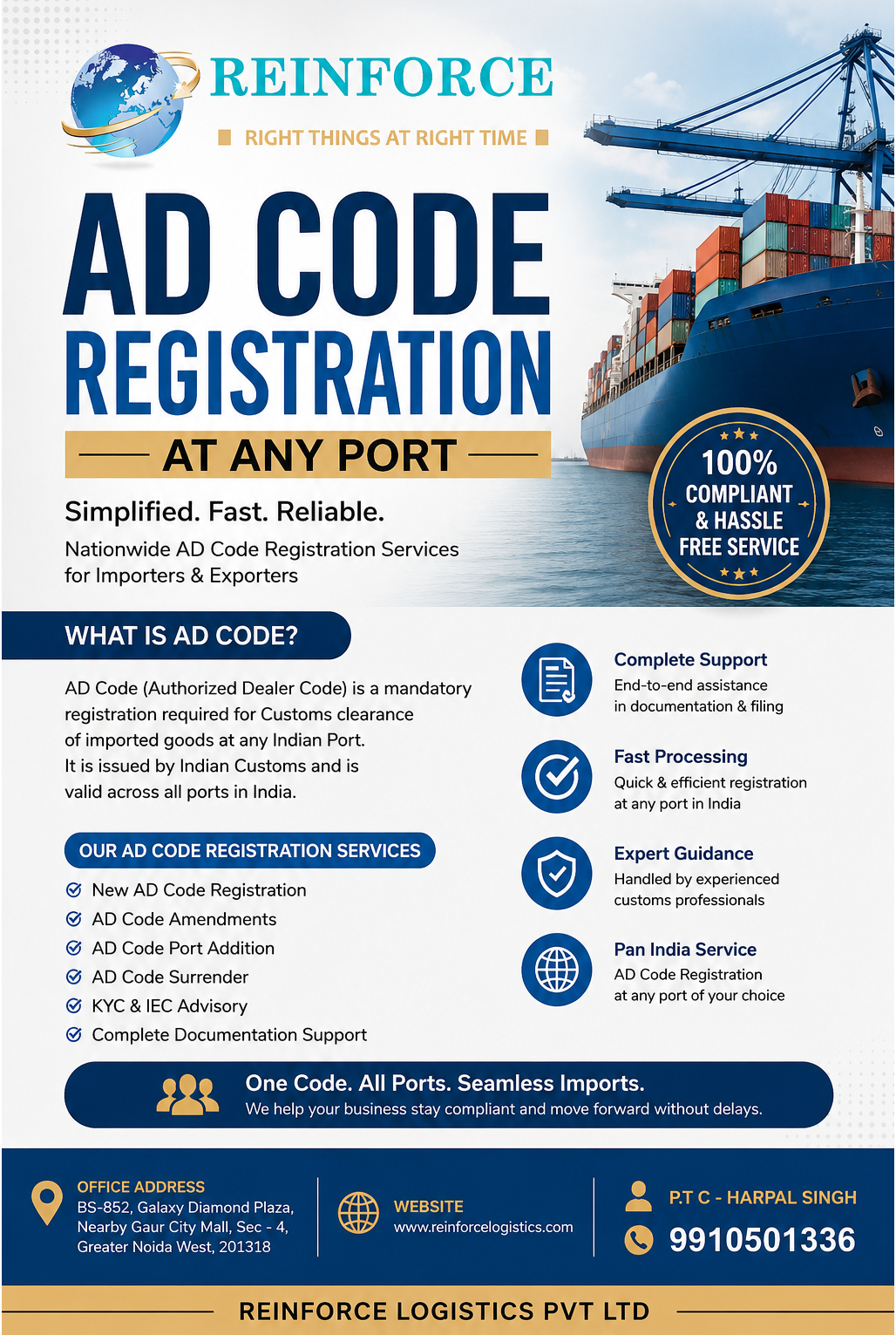
AD Code Registration at ICEGATE is the process of registering the bank account and Authorized Dealer Code details associated with an exporter against the relevant customs location through the ICEGATE system.
ICEGATE's official advisory explains that the facility allows registered users to add or modify bank-account details for export incentives and for declaring banks used for foreign remittances.
In simple business language:
Your company has an export order → your bank handles foreign-exchange transactions → the bank has an AD Code → the relevant bank account and customs location are registered through ICEGATE.
This creates an important link between your:
- Exporter identity
- Bank account
- Authorized Dealer bank
- Customs location
- Export documentation
What Does AD Code Stand For?
AD Code = Authorized Dealer Code.
ICEGATE documentation describes the Foreign Remittance Account category as the place where the banks used for making foreign remittances are declared.
The AD Code should not be confused with:
- IEC
- GSTIN
- IFSC
- PAN
- ICEGATE Login ID
- Bank Account Number
Each serves a different purpose.
A Simple Example
Suppose ABC Engineering Pvt. Ltd., Greater Noida receives an export order worth USD 25,000 from a customer in Germany.
The company has:
- IEC
- GST registration
- Current account
- Authorized Dealer bank
- AD Code
- IFSC
- ICEGATE registration
Before moving the shipment, the exporter should ensure that the relevant bank account and customs location are properly registered according to the applicable ICEGATE process.
This preparation can help prevent avoidable documentation problems when the shipment reaches Customs.
CTA: Planning your first export? Get your bank and customs registration requirements checked before cargo dispatch.
Why Is AD Code Registration Important for Exporters?
International trade involves several parties working together:
Exporter → Bank → Customs → Customs Broker → Freight Forwarder → Airline/Shipping Line → Overseas Buyer
If the bank and customs information is incomplete or incorrect, the exporter may face operational difficulties.
ICEGATE's advisory states that AD Code bank-account registration is used for export incentives and declaration of banks used for foreign remittances. The advisory also states that AD Code bank-account registration is mandatory for drawback refund claims by an IEC holder.
This makes AD Code registration an important part of export compliance.
Key Reasons to Complete AD Code Registration
1. Export Compliance
The registration forms part of the customs and banking framework applicable to exports.
2. Export Incentives and Refund Processes
Bank-account registration is relevant to applicable export incentive/refund processes. ICEGATE specifically provides bank-account management functionality for these purposes.
3. Customs Readiness
Having the required bank and customs information ready before shipment helps your Customs Broker prepare the export process more efficiently.
4. Reduced Last-Minute Problems
A common mistake is arranging cargo first and checking registrations later.
For an urgent export shipment, this can put unnecessary pressure on the exporter, freight forwarder and Customs Broker.
5. Better Financial Documentation
The exporter can maintain a clear record of:
- Bank account
- AD Code
- IFSC
- Customs location
- Registration status
- Supporting documents
AD Code vs IEC vs IFSC vs ICEGATE Registration
Exporters frequently confuse these terms.
They are not interchangeable.
Registration / CodeFull FormMain PurposeIECImporter Exporter CodeIdentifies an importer/exporterAD CodeAuthorized Dealer CodeIdentifies the Authorized Dealer bank branch for relevant foreign-trade processesIFSCIndian Financial System CodeIdentifies a particular bank branchGSTINGoods and Services Tax Identification NumberGST identification and complianceICEGATE RegistrationCustoms electronic registrationProvides access to relevant Customs electronic servicesBank AccountBusiness current/savings accountHandles business banking transactions
ICEGATE's current registration pages show that users can register on the portal and access various registration-related facilities after login.
AD Code and IFSC Are Different
This is particularly important.
An IFSC code is used to identify a bank branch for electronic banking transactions.
An AD Code relates to the Authorized Dealer bank branch used in the foreign-exchange/trade framework.
Therefore:
IFSC ≠ AD Code
Do not enter an IFSC where an AD Code is requested.
Example
Your bank may provide:
Bank: XYZ Bank
Branch: Greater Noida
IFSC: XYZB0001234
AD Code: 1234567
The two codes identify different things.
Always use the details provided by your bank and the applicable ICEGATE/customs workflow.
CTA: Unsure whether your bank has provided the correct AD Code? Ask your Authorized Dealer bank for written confirmation before submitting the registration.
Who Needs AD Code Registration?
The requirement depends on the nature of the export transaction and applicable customs procedures.
However, businesses that regularly export commercial cargo should treat AD Code and bank-account registration as an important part of their export setup.
This includes:
Manufacturers
Engineering, automobile, textile, chemical and pharmaceutical manufacturers exporting finished goods.
MSMEs
Small and medium-sized businesses starting international trade.
E-Commerce Exporters
Online sellers expanding from domestic sales into commercial international exports.
Merchant Exporters
Businesses purchasing goods from Indian manufacturers and exporting them overseas.
Established Exporters
Companies already exporting through one customs location and expanding to additional ports or ICDs.
AD Code Registration at ICEGATE: Basic Process
The exact ICEGATE screens and workflow may be updated from time to time. Exporters should therefore follow the latest official ICEGATE instructions.
The current ICEGATE portal continues to publish AD Code guidance and bank-account management material.
The broad process is:
Step 1: Obtain a Valid IEC
Your business should have a valid Importer Exporter Code (IEC).
The IEC identifies your business for import-export activities.
Before proceeding, check that the IEC details are accurate.
Pay attention to:
- Legal entity name
- PAN
- Address
- Bank details
- Contact information
Step 2: Maintain an Appropriate Business Bank Account
Your export transactions should be linked to the appropriate business bank account.
Check that:
- The account belongs to the exporter
- The company/firm name is correct
- The account number is accurate
- The bank branch is correct
- The IFSC is correct
- The bank can handle applicable foreign-exchange transactions
A mismatch between company and bank records can create unnecessary verification questions.
Step 3: Obtain AD Code Details From Your Bank
Contact the bank branch that handles your foreign-exchange transactions.
Ask the bank for the applicable:
Authorized Dealer Code / AD Code details
Do not try to calculate, modify or substitute the code yourself.
Why?
Because the AD Code is associated with the Authorized Dealer bank branch.
The ICEGATE system's bank-account management documentation specifically displays fields such as:
- Location Code
- Bank Name
- AD Code
- Account Number
- Status at Customs
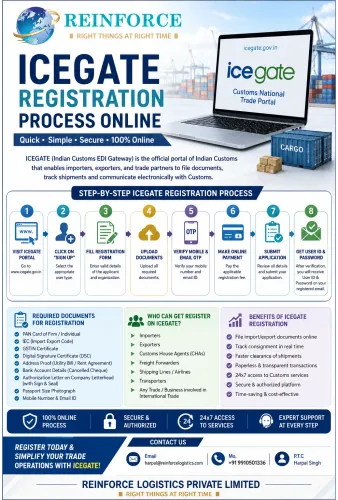
Step 4: Register on ICEGATE
If your business does not already have the required ICEGATE registration, complete it first.
ICEGATE's registration page currently instructs users who are not registered to use the Register Now facility.
This is important because AD Code bank-account management is handled through ICEGATE's electronic system.
Practical Advice
Do not create your ICEGATE account when your export cargo is already waiting for customs clearance.
Complete the registration during your export planning stage.
Step 5: Add Your Customs Location
The customs location matters.
For example, a Delhi NCR exporter may plan to use:
- ICD Dadri
- ICD Tughlakabad
- Delhi Air Cargo
Another exporter may use:
- Nhava Sheva/JNPT
- Mundra
- Chennai
- Kolkata
ICEGATE's AD Code advisory instructs users to ensure that their ports of operation are added to their registered user profile.
Therefore, do not assume that registering your bank information automatically means every customs location is ready for your shipment.
Step 6: Select the AD Code / Foreign Remittance Account Option
According to the ICEGATE advisory, users can select:
Foreign Remittance Account (Authorized Dealer Code)
The system then provides the relevant bank-account registration functionality.
The current ICEGATE bank-account management manual also describes the Foreign Remittance Account (AD Code) category and the information displayed for registered accounts.
Step 7: Enter Bank and AD Code Details
The information may include:
- Bank name
- Branch
- AD Code
- Account number
- Customs location
- Supporting documentation
The exporter should carefully compare every field against the bank-issued document.
Never Guess Bank Information
For example:
Wrong approach:
“IFSC is available online, so I will enter it as AD Code.”
Correct approach:
“Let me obtain the Authorized Dealer details directly from my bank and compare them with my company documents.”
Step 8: Upload Supporting Documents
The applicable ICEGATE workflow may require supporting bank documentation.
Keep digital copies of:
- AD Code letter
- Bank certificate
- Cancelled cheque
- IEC
- Company KYC
- Authorization documents
The exact documents can depend on the current process and the nature of the application.
Step 9: Submit and Track the Application
After checking the details, submit the request through the applicable ICEGATE workflow.
Do not assume that clicking Submit means your compliance work is finished.
Track the application and retain evidence of the registration/status.
What Documents Are Generally Required?
The exact document list can vary depending on the exporter, bank and applicable customs process.
However, an exporter should keep the following ready:
Essential Exporter Documents
- Valid IEC
- PAN
- GST registration, where applicable
- Company/firm KYC
- Bank account details
- AD Code letter/certificate
- Cancelled cheque or bank proof, where required
- IFSC details
- ICEGATE registration details
- Authorization letter, where applicable
- Customs-location details
- Supporting documents required by the current ICEGATE workflow
Document Matching Is Critical
Before submission, compare:
IEC Name = Bank Account Name = AD Code Documentation = Company Legal Name
If these records are inconsistent, investigate the discrepancy before submitting.
For example:
ABC Engineering Private Limited
should not casually appear as:
ABC Engineering Pvt. Ltd.
on one document and:
ABC Engineering
on another if the difference creates an actual legal/entity mismatch.
The correct approach is to use the exact legal details appearing in the relevant official records.
CTA: Keep one master export-compliance folder containing your latest IEC, bank certificate, AD Code letter, cancelled cheque and company KYC.
AD Code Registration for Delhi NCR Exporters
Delhi NCR has a large concentration of:
- Manufacturers
- Exporters
- MSMEs
- Automobile companies
- Engineering businesses
- Textile businesses
- Pharmaceutical companies
- E-commerce companies
- Electronics businesses
- Chemical companies
Many businesses in this region use inland customs locations and airports for international shipments.
For a Greater Noida or Noida exporter, the export logistics chain may look like:
Factory → Trucking → ICD Dadri / Delhi Air Cargo → Customs Clearance → Airline/Shipping Line → Overseas Destination
In this environment, AD Code registration should be considered alongside:
- Export documentation
- Customs clearance
- Freight booking
- Cargo movement
- Insurance
- Certificate of Origin
- Shipping Bill
- Destination-country requirements
Why Local Logistics Expertise Helps
A registration problem does not exist in isolation.
Suppose your shipment is ready at your factory in Greater Noida.
Your freight forwarder has booked space.
Your overseas buyer expects the cargo.
But your bank details or customs registration is incomplete.
The issue can affect the entire shipment schedule.
This is why exporters benefit from planning documentation and logistics together.
CTA: If your business is located in Noida, Greater Noida, Ghaziabad, Delhi or Gurgaon, discuss your customs and freight requirements before your first commercial export.
1st Time SIIB KYC at ICD Dadri
For a first-time exporter using ICD Dadri, businesses should also ask whether any first-time exporter KYC or verification requirement applies to their case.
SIIB generally refers to the Special Intelligence and Investigation Branch within Customs.
The objective of KYC verification is to establish the genuineness of the importer/exporter and relevant business information.
A customs-related adjudication record has referred to an undertaking for a first-time exporter to get KYC checked from SIIB at ICD Dadri.
However, businesses should not assume that every exporter will follow exactly the same verification path.
The applicable requirement should be confirmed with the concerned Customs Broker/customs formation for the particular case.
Documents You Should Keep Ready
For a first-time exporter, it is sensible to organize:
- IEC
- PAN
- GST certificate
- Company incorporation documents
- Address proof
- Bank documents
- AD Code documentation
- Authorized person's ID
- Authorization letter
- Nature-of-business details
- Factory/office details
- Purchase/sales documentation where relevant
Example
Imagine a Greater Noida manufacturer exporting industrial components for the first time.
The company has received a confirmed order from a UAE buyer.
The cargo is packed and ready.
If the exporter checks SIIB/KYC requirements only after the shipment reaches ICD Dadri, the business may face unnecessary operational pressure.
A better sequence is:
Export Order → Compliance Check → Bank/AD Code → ICEGATE → KYC, if applicable → Freight Booking → Cargo Movement → Customs Clearance → Export
This is a much more controlled approach.
CTA: First-time exporter from Delhi NCR? Ask your Customs Broker about applicable KYC requirements before moving cargo to ICD Dadri.
A Major 2025 Update: Auto-Approval for Certain Bank Account and IFSC Registrations
Exporters operating through multiple customs locations should know about CBIC Circular No. 24/2025-Customs dated 7 October 2025.
The circular states that the system will automatically approve requests for registration of the same incentive bank account and IFSC combination for an IEC at different customs locations when that same combination has already been approved at one customs location, subject to the conditions specified in the circular.
The circular also states that the existing submission workflow remains unchanged, but qualifying applications are approved directly by the system rather than being routed to a port officer for manual approval. After system approval, the request continues to PFMS for validation under the existing process.
Why Is This Important?
Consider an exporter already operating through one customs location.
The business then expands to another customs location.
Under the qualifying conditions of the 2025 circular, the same incentive bank account and IFSC combination may receive system auto-approval at the additional location.
This can simplify expansion.
But Do Not Assume Automatic Approval Everywhere
The circular applies to a specific combination and specific conditions.
Therefore:
Auto-approval does not mean “all registrations are automatically approved.”
Always check the current ICEGATE/CBIC procedure applicable to your transaction.
CTA: Expanding from ICD Dadri to another port? Review the latest bank-account and IFSC registration requirements before your next shipment.
AD Code Registration: Practical Exporter Checklist
Before your first shipment, check:
- IEC is valid
- PAN details are correct
- GST details are correct
- Business bank account is active
- Bank account belongs to the exporter
- Authorized Dealer bank branch is confirmed
- AD Code is obtained from the bank
- IFSC is verified
- ICEGATE registration is completed
- Customs location is correctly identified
- Port/location is available in the ICEGATE profile
- Supporting bank documents are ready
- AD Code registration request is submitted
- Registration/status is checked
- Approval evidence is saved
- First-time KYC/SIIB requirement is checked for ICD Dadri, where applicable
- Customs Broker has the required documents
- Freight forwarder has the shipment documents
Common Mistakes Exporters Make
Mistake 1: Confusing IFSC With AD Code
Solution: Obtain both details directly from your bank.
Mistake 2: Registering the Wrong Customs Location
Solution: Confirm the actual port/ICD where the export transaction will be processed.
Mistake 3: Waiting Until Cargo Is Ready
Solution: Complete registration during export planning.
Mistake 4: Ignoring First-Time KYC
Solution: Ask about applicable KYC requirements before the first shipment.
Mistake 5: Using an Old Bank Certificate
Solution: Use current bank documentation.
Mistake 6: Entering Bank Details Manually Without Verification
Solution: Compare every number against the bank-issued document.
Mistake 7: Assuming Approval Is Instant
Solution: Allow adequate planning time and monitor the application.
Mistake 8: Treating AD Code as a One-Time Universal Setup
Solution: Check the requirements for each customs location and the latest CBIC/ICEGATE workflow.
Expert Tips From a Logistics Perspective
Tip 1: Complete Compliance Before Cargo Movement
Your logistics plan should start before the truck leaves the factory.
Tip 2: Create an Export Master File
Keep all recurring company documents in one controlled folder.
Tip 3: Ask Your Bank for Written AD Code Confirmation
Do not depend on verbal information.
Tip 4: Tell Your Freight Forwarder Your Export Location Early
The forwarder can then plan the customs and transportation workflow correctly.
Tip 5: Treat Your First Export Differently
A first export requires more preparation than a routine shipment.
Tip 6: Review Changes When You Add a New Port
Do not assume your existing registration automatically covers every new customs location.
Tip 7: Maintain a Compliance Calendar
Review your:
- IEC
- GST
- Bank details
- AD Code
- ICEGATE account
- DSC
- Company KYC
- Customs authorizations
regularly.
Why Choose Reinforce Logistics Private Limited?
Reinforce Logistics Private Limited is a Delhi NCR-based logistics company providing integrated international freight forwarding and customs support.
The company operates from Greater Noida and supports customers across India.
Its logistics services include:
- International Freight Forwarding
- Customs Clearance
- Air Freight
- Sea Freight
- Import-Export Logistics
- LCL Consolidation
- Door-to-Door Cargo Delivery
- Warehousing Support
- International Courier
- Export Shipment Coordination
For an exporter, this integrated approach matters.
You do not need only a registration.
You need a partner who understands how registration connects with:
Bank → Customs → Cargo → Freight → Documentation → Destination
That is where Reinforce Logistics can add practical value.
Company philosophy: “Right Things at Right Time.”
CTA: If you are preparing your first export from Delhi NCR, contact Reinforce Logistics for customs clearance, freight forwarding and export logistics support.
Learn AD Code Registration at ICEGATE, required documents, bank account registration, customs location, IFSC and first-time exporter compliance.